Showing posts with label finance for SME. Show all posts

Thursday, March 15, 2012

Delayed GST - major cause of worry for MSMEs, says IndiaMART CEO Dinesh Agarwal

With the ongoing pre-budget phase of Union Budget 2012-13, the most fertile minds of Indian Micro, Small and Medium Enterprises (MSMEs) are already discussing desired outcomes for next fiscal and bringing forth their recommendations.

Underlining his recommendations for the Budget, Mr. Dinesh Agarwal, Founder and CEO, IndiaMART.com, shares, "The MSME sector, having contributed tremendously to the Indian economy, has always lacked requisite support from all quarters. The time is ripe to support and equip them to establish their strong foothold in domestic and international markets.

Many believe that credit crunch is the biggest worry for MSMEs. However, they overlook the fact that higher and multiple taxes, and compliance with multiple departments are the key challenges for them due to their small set ups and thin management. We request the hon'ble Finance Minister to simplify and unify taxation for MSMEs in this year’s Union Budget. Also, consolidation of multiple departments will help address issue of compliance. It will help MSMEs rise above pertinent issues of conforming to several norms and lengthy, time-consuming paper-work.

Also, the delay in GST implementation has marred hopes of many MSMEs. They fear that now it may get rolled out in a much complicated form, not in its original shape. To tackle this, a pragmatic approach towards faster implementation of GST is required.”

Mr. Makrand Appalwar, CMD, Emmbi Polyarns Limited, Mumbai, also finds faster GST implementation as the most important requirement today and urges government to kick start it at the earliest.

Mr. Agarwal adds, “Essential infrastructural necessities such as land, power, connectivity, et al may seem to be very basic, but in reality they are extremely crucial for MSMEs’ growth. For this, more industrial zones with reasonable land prices must be announced while continuous power supply must be made available to factories, manufacturing set ups of MSMEs.” Mr. Dinesh Kotian, Partner, Ace Heat Tech, says, "Every enterprise aims to grow bigger and so do SMEs. Expensive industrial land comes as a major hindrance along with high interest rates in company's expansion plans. Steps should be taken to offer subsidized land and interest rates to SMEs. Also, a substantial number of SMEs have their setups in outskirts of cities. Unfortunately, basic infrastructural requirements like road connectivity, power supply, etc. are not in good condition in such areas. Government should pay attention here as well." Adding to this, Mr. Appalwar says, "Development of port infrastructure is very vital as the efficiency of exports depends majorly on it. We have a single port operational here in Mumbai and if any fault happens at the back end, entire operations suffer."

On the other hand, Mr. Agarwal praises government’s efforts for bringing effective policies that have helped build ‘communication infrastructure’ in country in the last 15years. He states, “What is now required is better and low-cost broadband services across the country, especially in tier-II and tier-III cities. This would allow MSMEs to utilize enormous business opportunities present online.

Strong steps are required from our government to free MSMEs from the credit crunch worry too. Execution of priority sector lending policies for MSMEs demands rigorous approach. Also, Credit Guarantee Fund Trust for Micro and Small Enterprises (CGTMSE) needs to widen its ambit and cover more MSMEs which can avail collateral free financing. This will help entrepreneurs to overcome financial hurdles while setting up their projects or scaling up.

We also look forward to extension of facilities (such as Zero Duty Export Promotion Capital Goods (EPCG), Status Holder Incentives, etc.) for exporters under Foreign Trade Policy till March, 2014 instead of the current time line i.e. March 31, 2012. This will encourage MSMEs to achieve higher export figures.

We hope to see a budget that addresses key requirements of MSMEs in terms of basic infrastructure, simplification of taxation, easy access to funds, among others.”

Wednesday, March 7, 2012

MSMEs want Centre to offer access to sufficient credit: FISME

Indian Micro, Small and Medium Enterprises (MSMEs) have requested Centre to offer access to sufficient credit, which is important for survival and growth of SME production. 
 
The Federation of Micro, Small and Medium Enterprises (FISME) in the budget proposal to the Union Finance Ministry has stated that the venture capital and private equity funds are required by the SME sector to commence new ventures and surge the current ones.

The securitisation of trade receivables is likely be introduced to allow the bond market to develop and also lure funds in large volumes and at concessional rates in the interest of MSMEs.

Moreover, FISME has said that Non-Banking Financial Companies (NBFCs) can help to offer finance to the micro and small enterprises, but they are required to be actively boosted via supportive policies.

Thursday, February 23, 2012

SME Exchange of BSE to see first IPO today

Bombay Stock Exchange
The Bombay Stock Exchange (BSE) will commence its small and medium enterprises (SME) platform with Rs 8.50-crore initial public offer (IPO) of non-banking finance company (NBFC), BCB Finance.
 
The IPO will open for subscription today. It will be the first issue to be traded on the segment during March. The firm will secure Rs 8.85 crore via the issue, which will end on February 27 and the issue price has been set at Rs 25 per share.

BCB Finance is mainly involved in the business of advancing loans and investing/trading in securities. If the IPO attains success, it is expected to pave the way for the listing of other firms on the platform. 

Both the bourses, BSE and NSE have been facing pressure from Centre to unveil a separate trading platform for SMEs.

Tuesday, February 21, 2012

Challenges Faced by SMEs in Developing Countries

Small and Medium Enterprises (SMEs) are an integral part of any economy and play a vital role in supporting a stable economic environment. They are crucial in upholding the growth and existence of economy especially that of developing countries. SMEs are driven by combined efforts of private entrepreneurs, government and financial institutions.

Developing financial sensibilities

One of the key elements for an SME’s success is access to finance. In developing countries, SMEs face a number of hurdles while achieving the financial resources for building up of their businesses. Finance is crucial for any SME to acquire or absorb innovative technologies. Their expansion to global markets or association with other firms is also related to the availability of finance. Traditionally, SMEs find it difficult to avail credit or equity. Even maturities of commercial bank loans offered to them are limited to a very short period. Similarly, lower interest rates are extended to a very few companies.

SMEs are often considered to be high-risk borrowers because of insufficient assets and their vulnerability to market fluctuations. They are also very much susceptible to mortality. The existence of an information asymmetry caused due to lack of records in accounting and inadequate business plans often make them a difficult choice for creditors and investors. Also, the high cost of transaction or related administrative costs of lending small amounts make lending to SMEs a risky proposition. Even then, banks turn out to be the biggest supporters of SMEs. It has also been proven that banks would benefit commercially from lending to SMEs. 

Plan your finance and take the right ladder to growth
Find the right investors
Besides assistance from banks, SMEs can also rely on private equity firms which are experienced and expert in their businesses. They would prefer to invest in businesses which have a potential to grow. Many SMEs do not prefer such investments because of the interference by the equity firm members. However, there are certain investor firms who prove to be a viable option for funding as they use their own money for funding various initiatives.

Society has seen a new spurt of CEOs and successful entrepreneurs who are investing in new ventures and ready to support upcoming SMEs. These investors also provide their expertise to the firm and support them with their management skills. Bombay Stock Exchange (BSE) has already kick started its SME platform with the Rs 8.5 crore initial public offer (IPO) of a non-banking finance company (NBFC), BCB Finance. This has set high hopes for Indian SMEs who can now raise domestic capital for their own requirements through this way.

Alternatively, since SMEs have a bigger scope of getting their funds from banks, they can improve their credibility. Another solution offered is maintenance of better business plans, improved credit ratings and maintaining reliable financial information which would help banks and financial institutions in having more confidence in lending to SMEs.

SMEs can also go in for mergers with other firms to complete their fund requirements. Mergers also provide them opportunity to enter into international markets and form strategic alliances to expand their business and enter new productions. SME sector of any country is expected to drive the growth of any country’s economy and offer a significant opportunity for various investors to contribute in the future of a country.

Tuesday, January 31, 2012

BSE, NSE gear up to launch SME trading

In a major financial move, Bombay Stock Exchange (BSE) and National Stock Exchange (NSE) are gearing up to begin trading in the small and medium enterprises (SME) sector. A formal announcement is yet awaited, even as, market players stress that the key problems related to market-making and other costs are yet to be ascertained.

The First Steps


Previously, the Securities and Exchange Board of India (SEBI) had prepared a three-year criterion on market-making for SMEs which were planning a listing. This step was to ensure optimum liquidity and options for investors to exit. Generally, market makers are expected to forward two-way quotes. But, stock exchanges, which operate as facilitators to companies by linking them with merchant bankers, have failed to reveal specific details of costs related to market-making and other expenses.

In this system, in the first three years, there would be a market maker for a public issue who will be responsible for supporting sustenance of the offer by allocating a two-way quote. He will practically hold a certain number of shares of a particular SME and will assist trading in that security. When a buy order is received, he would immediately sell from his own share or seek an offsetting order. The process will support transactions in SME securities and also provide liquidity to them. SMEs would be expected to pay a certain fee to the market makers, which would contribute to cost of raising equity.

Way the Exchange Works

While one of the exchanges puts the entire expense of an issue around 8-10 per cent of the entire money raised, the other offers varied calculations. The exchanges are unwilling to look at companies with small fund requirements and want companies which want to raise at least 5 crores. Exchanges are expected to start with promising companies with ample growth potential. 
 
SEBI mentions that SMEs are allowed to raise amount as less as Rs 5 lakh and up to Rs 5 crore. Any enterprise whose post-issue capital has a face value of between Rs 50 lakh and Rs 10 crore can be included on the SME Exchange. Businesses with post-issue capital ranging between Rs 10 crore and Rs 25 crore can choose to be on the SME Exchange or the main exchange. A capital of over Rs 25 crore makes the companies eligible for the main board.

There are other fees for underwriting and sub-underwriting of a particular issue. Another point of concern is the fact that an investment banker will underwrite 15 per cent of the issue using his own resource and can include external investors for the remaining 85 per cent.

Calculating the Cost of an Issue

NSE officials estimate the cost of a particular issue as per the cost quoted by merchant bankers to their clients. They are planning to introduce a ‘call auction mechanism’ which would allow them to break the continuous trading sessions spanning the entire day into sessions of few minutes held on regular intervals. This is expected to bring down the market making cost and create a proper system to address cost issues.

SMEs are also expected to gain with the onset of many venture capitalists and foreign funds and the emergence of the India Venture Board which is proving to be a viable platform for SMEs.

Saturday, January 7, 2012

Expert Speak: Mr. GK Pramod

Back to Basics to Achieve Profitability for SMEs

With the ever changing demand and supply dynamics of the markets, SMEs do feel pressurized to meet the requirements. The major challenge which they came across is to sustain and fulfill the requisites without hampering enterprise's profitability.

After covering two 'Sutras' for effective business growth - Scalability and Sustainability, we will have a session on third Sutra – Profitability in this blog. By understanding its various aspects, you can imply them practically and make them instrumental to accomplish organisational growth.

Profitability
A Microlevel organization is said to be Profitable when it makes enough profit to take care of its employees, customers, investors and the Microlevel Entrepreneur in a satisfied manner.

Importance of Profitability
  • Profitability plays an important role in motivating the Microlevel Entrepreneur in the right direction
  • If the profitability is not in there in the business, it becomes extremely difficult for a Microlevel Entrepreneur to continue in the business
Do’s
  • Make sure the business unit makes profit from day one of its operation
  • Cut down all unnecessary expenses
  • Make sure that the Microlevel Entrepreneur focuses on the core business
Dont’s
  • If the existing unit is not making profit, first make sure that it becomes profitable
  • Don’t open up a new business unit if the first unit is not profitable
  • Don’t spend extra money on additional resources
Case Study:

Case Study-1: (Product Business)

Ms. Usha is a Microlevel Entrepreneur from Mysore in Karnataka. She is selling natural fresh juice. The details of Ms. Usha’s business organization unit are as follows:

1) Name of the entrepreneur:               Ms. Usha
2) Name of the organization:                Sushruta Fresh Juice Centre
3) Nature of business :                         Sale of Natural fresh juice
4) Details of turnover for the past 3 years:


Let us understand the analysis regarding Profitability factors for Ms. Usha’s business (Product Business):
  • Ms. Usha’s business has made 30%, 35% and 40% profit in the past 3 years
  • She is making good profits
  • As the turnover is increasing, she is also able to increase the profit margin
  • This is a good, profitable business
Challenges in Profitability
  • Uniformity in production and  packaging. 
  • To create awareness among their customers that natural fresh juice will provide good health.
Case Study-1: (Product Business)
 
Mr. Charan Singh is a Microlevel Entrepreneur from Jalandhar in Punjab. He is selling fertilizers. 
                                                                                                                 
The details of Charan Singh’s business organization unit are  as follows:
1) Name of the entrepreneur:                  Mr.Charan Singh
2) Name of the organization :                  Guru Gobind Agro
3) Nature of business :                            Selling fertilizers, Seeds and Chemicals
4) Details of turnover for the past 3 years:


The analysis regarding Profitability factors for Mr. Charan Singh’s business (Product business) suggest:
  • Mr. Charan Singh’s business has made 10% profit in the Past 3 years.
  • He is not making good profits.
  • As the turnover is increasing, he is not able to increase the profit margin.
  • This is not a profitable business.   
Challenges in Profitability
  • Mr. Charan Singh is making a large turnover but less profit.
  • The challenges for Charan Singh are to increase his profitability along with his turnover.
Key Points to remember:
  • Make sure that the existing business unit is profitable. Increasing the profitability doesn't necessarily mean, you may have to open up more units. You can increase the profitability either by increasing the price for your products/services or increasing the customer base.
  • Once the existing unit becomes profitable, a Microlevel Entrepreneur can think of opening new business units.
With this the journey of understanding the three vital 'Sutras – Scalability, Sustainability and Profitability' for business growth ends here followed up by your actions to implement them practically in the business growth strategies and witness the difference.

We will continue our journey of understanding various 'must know' topics for Small and Medium Enterprises (SMEs) in the subsequent blogs.

The blog has been authored by Mr. GK Pramod, Co-founder, The Second Gear - MBA for Non MBA's Mentoring Module Concept.

To contact the author, e-mail at gk@tothesecondgear.com

Leave your comments and queries here:

Friday, December 23, 2011

Absence of loans, high interest rates affecting Indian textile SMEs: Rita Menon

The lack of loans and high interest rates are heavily impacting the small and medium enterprises (SMEs) in the textile sector, said Ms Rita Menon, Textiles Secretary. 
 
Ms Rita Menon, said, “SMEs in sectors like silk sector, power-loom and spinning are hit because of lack of working capital and high interest rates.” This statement has come on the sidelines of Apparel Export Promotion Council (AEPC) function here. 

The Union Finance Ministry is reviewing a loan restructuring proposal for the textile sector and a decision may come soon. 

The Textiles Ministry is not eyeing for 'cash outgo but a moratorium on loans for two years so that the working capital could be secured for that time period. The step of suspension of loan repayment for two years would be helpful in protecting the units from becoming non-performing assets.

Wednesday, June 1, 2011

Free Accounting Software for Your Business: Adminsoft Accounts

Finances for any business are one of the most crucial aspect. A business which is sound financially is one which is able to run the extra miles. Financial accounting for any business is a critical task and moreso from the perspective that it helps understand where the business actually stands and what future growth can it expect. Its important for every business to be strong financially, moreso for the top management to be in close touch with their numbers always. Business decisions of every kind and nature are affected due to finances.

Challenge for the SMEs
For the emerging enterprises one of the critical challenges is to either have a specialized team in-house which handles finances or outsource the finance function, till the time they are able to do it themselves. This is an extended challenge for many entrepreneurs who are not well versed with the accounting aspects. SMEs generally are not aware of the various financial accounting tools, technology and objects which can go a long way in helping them align their accounting in the initial stages of the business.

The Freeway: Adminsoft Accounts helps manage your accounts
Adminsoft Freeware helps you record all your customer details, print sales invoices, keep track of who owes you money, record all your supplier details and keep track of who you owe money to, and so much more. Click on the Software button above for full details.


What are he various features of Adminsoft?
Adminsoft Accounting should not be mistaken for a free software with no value, it gives a multitude of features which are discussed under:

  • Multi-User
  • Multi-Company
  • Multi-Currency
  • Multi-Department
  • Customer Details Mapping
  • Supplier Details
  • Stock Details
  • Nominal/ General Ledger
  • Personnel/ Human Resources
  • Payroll


How can I download Adminsoft, if its free?
Being a free solution, You can easily download Adminsoft and not just that, to customize it to the hilt, you can also ask for the source code which will also help you build upon the already existing software!

Click the following link to download Adminsoft: http://www.adminsoftware.biz/download.html

Where can I get technical support from?
There are support and user forums on the Adminsoft accounts official website, which you can be a part of. These are user groups which discuss everything from general FAQ's to operational aspects of the software. You can find the user forums here: http://www.adminsoftware.biz/support.html and http://www.adminsoftware.biz/forum/index.php


There are many such online platforms available, which are benefiting the Small and Medium Enterprise segment. To know more, get in touch with the experts at IndiaMART Knowledge Services. Do drop in a comment to this post to let us know what else would you want us to share about!

Friday, May 20, 2011

The Free Personal Finance Advisor for SMEs: Google Advisor

Finance for SMEs is one of the most crucial topics. For many start-ups in India, which start as a proprietary company, managing finances becomes difficult for the founder, as most of the times his/ her accounts are the same as that of the companies. This becomes a challenge to maintain when you finally register your company and create, maintain and manage separate finances for the same.

Your free personal finance advisor
Google has recently launched its free personal finance management tool called Google Advisor. The tool helps you find and compare various financial products.


The tool helps you check on and compare for mortgages, CDs, Credit Cards, Loans, by listing down a search criteria, for the user to choose from.

Is Google Advisor a financial product search engine?
No. Google Advisor is not a search engine. It's a recommendation engine, where it displays the various vendors registered with its service, their product offerings and the various features, benefits and conditions attached along. Essentially Google Advisor is a comparison tool with various criteria based filters.

How does it help you?
Not just personally, even if you are taking loans, or re-financing your assets, applying for a new credit card amongst other things, you are empowered to take a decision using the information provided by Google Advisor. The comparison engine lets you compare between various financial tools available and what suits you best. While being online, it helps you to save time and understand at your own pace, after assessing your requirement of what financial tool you exactly require and hence make an informed buying decision.


And why is the service free?
Though Google does not make money on any other feature, if you apply for a loan online through one of the listed vendors on Google Advisor, Google gets a percentage.

There are many such online tools available, which are benefiting the Small and Medium Enterprise segment. To know more, get in touch with the experts at IndiaMART Knowledge Services. Do drop in a comment to this post to let us know what else would you want us to share about!

Tuesday, May 17, 2011

Expert Speak: Mr. Priyesh Maheshwari

Facilitating the Process of Availing Finance for SMEs
The relevance of Small and Medium Enterprises (SMEs) in any economy is very vital as they form a major chunk of the the economic activity. They play a key role in industrialization of a developing country like India. They have unique advantages due to their size, their comparatively high labor-capital ratio, focus on relatively smaller markets and need for lower investments. They ensure a more equitable distribution of national income, facilitate an effective mobilization of resources of capital and skills and stimulate the growth of industrial entrepreneurship.

Innumerous but significant initiatives are required in India for ensuring prompt supply of financial resources to SMEs, such as adequate credit delivery to SMEs, better risk management, technological up gradation of Banks (especially in rural and semi-urban areas), change in attitude of financiers and so on.

This would certainly involve education and upliftment of the SMEs. 

Two most important things for SMEs is to be aware of financing facilities for their business. It includes:

-Highlight your own financing requirements for business; and
-Be aware of financier’s requirements

Whenever any business has financing requirements, it should be well communicated to the existing financial institution/advisor. In case of absence of proximity to any financial institution, one can ask for references from their business associates. It is important to note that requirements should be clearly communicated in terms of amount, tenor, mode of repayment, end use and means to repay the same. This would also help the financial institution to provide the best suited option for the business.

Typically, any financial institution would look at strengths and composition of the management of the company, legality of the business, positive outlook of industry in which the business operates, acceptable financial conditions (including present position of revenues and capital structure as well as projection), collateral value (if applicable), quality and strengths of business plans, clean track records of repayments for any earlier borrowings by the company or promoter group.

A financier should not only provide finance for the business but should also timely educate the small business owners and help them grow. A financier-borrower relationship can start with a small financial assistance and gradually when mutual trust is established, finance facility can also grow with business. Fruits of patience would surely be awarded in future.

Likewise Religare group also believes in maximizing customer returns. As businesses grow, so do their needs. We at Religare Lending Business understand the SME needs and have tailor-made offerings and processes to facilitate customer growth. Whether it is for new plant & machinery, equipment or inventory purchase, working capital or business expansion, SME Loans from Religare lending business provides the finance to businesses and help them gain uninterrupted growth.

We understand this in a very simple equation. We exist for and because of our trusting customers and that in their growth is our growth. Hence our entire focus is to help guide our customers to the next level through our sector expertise, specialized products, simplified processes and documentation, doorstep service delivery and keep our customers at the centre of our universe.

The author of the article is Associate Vice President, Product & Strategy - SMEs, Religare Finvest Limited.

To gather more information on various business application for SMEs, get in touch with the experts at IndiaMART Knowledge Services. Do drop in a comment to this post to let us know what else would you want us to share about!

Friday, May 13, 2011

Free Online Bookkeeping Software: Numia

Finances for any business are one of the most crucial aspect. A business which is sound financially is one which is able to run the extra miles. Financial accounting for any business is crucial. Its important for every business to be strong financially, moreso for the top management to be in close touch with their numbers always. Business decisions of every kind and nature are affected due to finances.

Challenge for the SMEs
For the emerging enterprises one of the critical challenges is to either have a specialized team in-house which handles finances or outsource the finance function, till the time they are able to do it themselves. This is an extended challenge for many entrepreneurs who are not well versed with the accounting aspects.

Numia comes to rescue
Emerging technologies are helping SMEs across the world to adopt newer methods of solving challenges which are critical to their business. There are many online solutions which are helping entrepreneurs to understand financial accounting, Numia has the distinction of being free.


Key features of Numia: impacting your business
Numia is one of the powerful free accounting softwares, which enables SMEs to take charge of various accounting procedures with its features as:
  • Easy accounting
  • Free to register and easy to use
  • Easy navigation
  • Anywhere online access
  • Secured data transfer
  • Multiple users
  • Check print preview
  • Multiple reports
Numia records and processes small business accounting transactions within functional modules such as accounts payable, accounts receivable, trial balance etc. It functions as an accounting information system. This Bookkeeping Software provides an easy way to keep users accounts information online with reliable and secured data transfer. With easy forms for invoicing, purchase and bank reconciliation it is easy to maintain accounts.

Can I see an online demo of the software before making a decision?
Yes, the online demo is available on Numia's website.


You can also see the various features Numia provides you, under the following headers:
  1. Company
  2. Customer
  3. Vendor
  4. Banking
  5. Employee
  6. Reports
  7. User Accounts
This is shown in the screen capture below as an example:

Great, so how do I start using Numia for my business?
All that you need to do to start using Numia is, register online on the website as a business user. You can REGISTER ONLINE here. Once registered, you will get access to the free online accounting software Numia for your business.

With the advantage of being accessible anytime, anywhere, Numia enables you to be in touch with your business numbers at all times while on the move. Since this software is online, it makes the information available at all times to the business users. This helps small businesses reduce down the cost of technology, while becoming more process oriented.

There are many such online platforms available, which are benefiting the Small and Medium Enterprise segment. To know more, get in touch with the experts at IndiaMART Knowledge Services. Do drop in a comment to this post to let us know what else would you want us to share about!

Saturday, May 7, 2011

Accounting Made Easy for SMEs with OneStepAccounting

Finance, without a doubt is one of the major critical activities for any business. Especially for the Small and Medium Enterprise. Managing finance is a critical activity which requires much expertise. As an example, almost every start-up agrees to the fact that apart from the core team they have, one of the crucial most elements of their team is a CA (chartered accountant) which is someone who handles the finance part for the start-up. With the emerging accounting standards and rules, along with laws of the land, you have to have softwares which make accounting easy for you and help you create processes within your company.


Challenge for SMEs: finance
The challenge that most of the SMEs face in terms of their finance is towards managing the various aspects of finance. For start-ups a simple, agile and inexpensive processes of managing finance is crucial.


Take it step by step with : OneStep Accounting
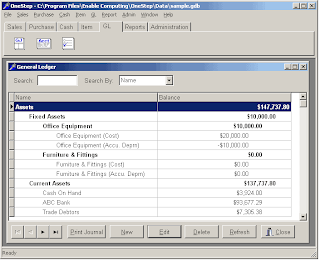
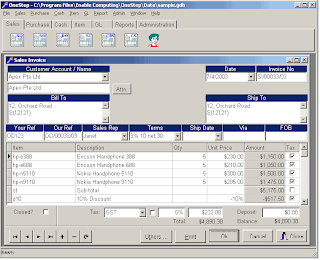
OneStep Accounting is an accounting plus business management software that is designed specifically for small and medium sized businesses. Packed with all the standard accounting features, such as general ledger, invoicing, bill paying, and inventory tracking in the standard edition, plus there are additional features like quotation, sales order, delivery order, purchase order and multi-users, to help you better manage your business.

Various features of the OneStep Accounting software are:

  1. is user friendly,
  2. is a real-time accounting system that provides up-to-date accounting data all the time,
  3. has functions that facilitate the full sales and purchase processes,
  4. supports customizable and multiple report formats,
  5. comes with a graphical report designer,
  6. is powerful, versatile and more 

But why should I use OneStep Accounting?
  • Tightly integrated modules
With all the modules tightly integrated, OneStep manages to simplify your data entry tremendously. Just key in your transaction (for e.g. sales/purchase invoice, credit/debit notes, etc) into OneStep and all the affected accounts (for e.g. customer/vendor accounts, sales account, inventory account, etc) will be updated automatically.
  • Support full sales and purchase processes
OneStep covers the full sales and purchase process. It also has functions to copy data from one type of document to another (for e.g. a sales quotation to a sales order, a sales order to a sales invoice, etc), saving you the need to re-enter the same data again.
  • Upto the second accounting information
OneStep is one of the new generation accounting systems that support real-time update. This means you will be able to get up-to-date data and reports any time of the day.
  • No more messy transaction records
You no longer have to grapple with messy records dotted by all the reversals and repeated entries in your transaction records. What´s more, if you turn on the audit trail feature, OneStep will keep a copy of the old transaction record every time a transaction record changes and that enables you to track the changes made.


How much does it cost?
You can fetch a free license to OneStep Accounting online HERE.

There are many such online platforms available, which are benefiting the Small and Medium Enterprise segment. To know more, get in touch with the experts at IndiaMART Knowledge Services. Do drop in a comment to this post to let us know what else would you want us to share about!


Saturday, January 22, 2011

Organisational Development: What Areas Should an SME Invest In?

Almost at all times, the Small and Medium enterprises fall into this trap of choosing from a whole list of activities which need to be done for growing the business and taking it to the next level.

We have many items on our list, but we need to invest, what should we do?
Money and resources (time included) are crucial for any company and moreso for the SME. You have to prioritize at various stages of organisational growth as to what do you as a business invest into, at the present and what should you be keeping for the future.

But to me everything seems important, its difficult to prioritize
Many a times SMEs have the similar state of existence, when everything seems crucial to business growth. At this stage the business leads (vertical heads/ business heads)/ people who are responsible for charting our business growth must collaborate together and brainstorm to ensure that everyone is at the same page, while discussing business growth.
This activity will help bring new perspective to the business. Only the CEO sitting at the top, making decisions, in cases of SMEs may not be the right approach to prioritizing.

Are there any particular pointers which you think can help us set our thought process right?
At IndiaMart, our experience with the SMEs over years has led to some very basic pointers which will provide a direction to your thought process, while you are in the process of prioritizing the re-investment into your business.

Some crucial and un-avoidable areas of investment for a growing business, which often get ignored are:
HR

  1. Training and Development
  2. Investment towards recruiting the right talent on-board
Branding
  1. Brand building - Internal and External
Corporate Communication
  1. Internal
  2. External
Technology
  1. Automation and Process Improvement
Customer Service/ Support
  1. Strong processes, making the customer support/ service strictly process oriented
Infrastructure
  1. Re-invest into your infrastructure, give your people an environment to work in, which they love
Knowledge Retention and Management
  1. Using technology you could retain critical knowledge and build practices around knowledge retention and management
Legalities
  1. Invest into the right legal advice to build robust accounting practices
Marketing
  1. Use internet for business promotion
  2. Use mobile to reach to to your set of target customers
  3. Go to events and make your brand visible
  4. Marketing/Sales collaterals
Process Development
  1. You must invest into process development - internally in your business. A process oriented organisation always has an edge over its competitors, people are more productive and all work towards achieving quality within their processes
One of the most important activity which must constantly be invested into is the improvement in an entrepreneur's own self. There has to be a constant up-gradation of the entrepreneur's self which keeps the competitive nature alive at all times and makes the team look upto the lead.

We are sure, as entrepreneurs you must be making many decisions of which area of the organisation to invest into such that you may derive the maximum benefit for your organisation. For more, drop in a comment and our team of experts will be happy to help!

Sunday, January 16, 2011

Choosing Your Investor: Lessons in Finance for the SME

Rising from the recession, with the economy getting back with strength, there are many new opportunities being churned and created, especially for the emerging SME sector. There is increased risk taking by the SMEs, which is spurning new areas of growth and development.
SMEs are increasingly becoming the backbone of the emerging Indian economy and one critical aspect of the entire chain is, funding/ investment.
The funding ecosystem in India for the SMEs
There are many sources of raising capital and funds for the SMEs in India, each with their own existence and functional methodology. SMEs may require funds at various stages of existence, from start-up to working capital and scaling up. Broadly classifying, the various ways of raising these funds are:

  • Angel Investment
  • Banks
  • Venture Capital
  • Private Equity etc.
But how do you choose your investor?
This is a major and critical step. Choosing your investor will always affect your business in more ways than one. As the stakeholders in the business increase, the responsibilities get more diligent and hence the ownership and also the decision making.
As you venture out on your entrepreneurial journey seeking funds, there will always be many good investors who would want to put money in your business. But it may not always be the best thing as an entrepreneur to give into all such offers and temptations.

Its like a marriage - a relationship of a man and a wife
The relationship between an investor and an entrepreneur is like the bond of matrimony. And any experience person would say that it is better to stay single, than to marry a wrong person, it is better to boot-strap your enterprise than to get stuck with the wrong investor.
Serious investors come on board with a thoroughly professional and experienced approach to investing and they have done it multiple times over years. They do their own due diligence before committing themselves/ their resources/ their money/ support to a budding enterprise.
A strong lesson for all emerging businesses is, while you are looking to raise funds, it does, in no way mean that you cannot have your say in choosing your own investor
What are the pointers that you must take into account while raising funds?

  • Are you prepared to share ownership?
Letting go, is one lesson which the entrepreneur must learn and be prepared with, even before going in the market to raise funds. Anyone who parts his money to invest into your business, will surely ask you to part with some ownership of the company, and the ownership status and rights may change. This change at times is not something which the entrepreneurs are always mentally prepared for.
  • Take help from experts
Raising funds is not an easy game. Valuations as a word in the English dictionary sounds very good, but not a word which would really be yours at all times and may not be music to your ears at all stages of your growth as a business.
The best way generally is to go to your successful entrepreneurial friends, who have been through the process, they are the best placed to share their insights and experiences.

Source: http://affordablehousinginstitute.org/blogs/us/wp-content/uploads/follow_the_money_small.jpg

  • Funds don't come in a jiffy
Fund raising is not like a part time job. It is a full time activity which requires a lot of focus and effort from the entire core team of your enterprise. It requires rigorous planning, focus, host of meetings and presentations. There is no particular template which you present your Bplan in which fetches you the magical money! Be prepared to shelve off time from your daily schedule towards raising funds in a focused manner.
  • Big words may not work big
Valuations, Equity, Shares, Projections, Net profit, Gross profit, P&L - these are all big words which you will encounter many a times during your process of raising funds, be sure of it. But what you must do is, to focus and ensure that the real thing is the transaction. The legal documents that you sign off. Read through each and every team and word carefully. Many a times you may or may not understand many terms, ensure you take help.
  • Dont' over raise
Your investor at times may be over generous and offer you more buck for your bang and similarly at times you may wan to raise more bang for your buck. Just as they say under-commit and over achieve/ deliver, well, even while raising funds, ensure that neither of you over promise things. Keep your roles and understanding very clear.
  • Investor's stake - is it only money?
Is your investor going to come on board with only money or is it the fact that he would bring in business as well? Ensure that your investor is someone who is as interested (if not passionate) in your business and has as much conviction in your execution capability, delivery, team, idea etc. that he adds value in the form of ideas, mentoring, advisory as well, other than just money.
Many a times, the actual value which a start-up needs other than money is, the right hand holding and mentoring.

Fund raising is critical to the growth of the business at the right times of the enterprise scaling up. Ensure that you are prepared well. To know more about raising funds, drop in a comment to this post and our team of experts will come back to you!

Tuesday, January 11, 2011

Innovation and The Small and Medium Enterprise

Innovation is the key! we all would have heard this statement many a times in our lives and must have tried our hands at it.

SME and the Growth: Role of the Government
The SME segment in India is a major contributing factor to the growth of the Indian economy. Creating an ecosystem that incubates and promotes innovation, requires policy intervention and funding by the government. For the growth to continue in a sustained manner, the Government has to create strong policies which support the growth of the SME ecosystem.

Cheaper - Quicker - Better: the Comparative Advantage!
One of the strongest winners for the SME is to deliver “cheaper, quicker, better”. Any SME, with a strong comparative advantage in any of these will sure be on the path to being a sure gainer. There are many examples to this thought: low-cost airlines and the mobile telecom sector have clearly demonstrated the advantages of being cheaper; “fast” food chains have built their businesses around “quicker”; many FMCG companies claim their success by being "better".

But Can SMEs thrive only on these three differentiators?
While there may be single companies building on one of these advantages, it is not really sustainable. There will always be a rapid convergence amongst all players in a marketplace on all three dimensions. It happens as the entire ecosystem evolves of which the small and emerging business is a part of.

What then is required for Sustainable Competitive Advantage?
Innovation!!  Innovating across your services, products, solutions and offerings can create powerful set of differentiating factors for your emerging business. In times today, continuous innovation is, the best way of ensuring on-going, long-term competitive advantage, especially in the knowledge and technology sectors. And as we are seeing almost every sector we know of today knowledge and technology becomes the integral part of the growth of any business, however small it may be.

Driving Innovation is sure an imperative in India
Innovation is an imperative and in a way a must to be accounted for emerging Indian businesses. Today as we are a billion strong, there are massive challenges at present and bound to increase in health, education, and food security. These are not small challenges, they cannot really be solved by conventional approaches; a small change will not really make a huge dent into these challenges; they need innovative and creative solutions that ensure radical change towards the better.

The Indian Advantage
Interestingly, in India, call it whatever you may, but we have the advantage of four key innovation-driving factors:

  • democracy
  • demography
  • diversity
  • adversity
But how can Indian SMEs really focus on Innovation with all the challenges?
Agreed, Indian SMEs have their own set of challenges. Our own experience with the SMEs has shown that: 
  • Indian SMEs still struggle while raising finance, though it has become more accessible in the recent past
  • The human resources created by the academia are not the best fit always
  • Government policies are not always best suited
But as they say, if we win through odds, we create history, many SMEs have risen up while facing these challenges while innovating purely.
Eg:
One of the strongest product start-ups from India, Zoho, based out of Chennai is one such example, where the intelligent use of human resources has proven the critiques wrong.

Innovation is not a KRA, its a culture
Innovation is not really a departmental approach to things within an organisation. Its not a KRA. Its not the task of a manager. Its ingrained in the culture. Its what an organisation creates as one of its pillars of strength and not only for the sake of it.

There is no fixed way/ model/ methodology in which you must drive innovation for maximum benefit. Its a cultural proposition which has to be custom built in the organisational value system and driven by passionate stakeholders.

A strong example could be the Google 20 percent time policy, wherein every employee at Google can spend 1 day every week, in doing things, which may not directly be related to his project. Here is one employee sharing his experience!

Innovation and taking India to the next level
Innovating across new business models, newer ways to be more productive, drive business and grow will ensure that more and more businesses from India emerge out to rise from being Small to large scale enterprises which are global in nature.

Be there at The SME Conference 2011 to know how to play in a globalized economy!

Saturday, January 8, 2011

Finance for the SME: Government Funding and Schemes

Every SME requires a continuous flow of funds not only in the initial start-up phases, but also for ensuring successful operational efficiency.

Raising funds for the SME: various ways:
There are multiple ways for SMEs today to raise funds. Also there are multiple factors which the SMEs need to consider while raising funds. At various stages of business the requirement of funds are different. They could range from setting up a new business vertical, to scaling up in terms of human resources to expanding geographically.

Some of the popular existant ways to raise funds for the SME are:

  1. Angel Funding
  2. Venture Capital
  3. Private Equity
  4. Government Schemes
  5. Banks

Focus: Government supported schemes!
There are many ways to meet financial requirement for the SMEs, the Government (both at the Central and State level) has taken several steps like formulating various policies and schemes, setting up of banks and financial institutions; etc.

This clearly shows the focus of the government towards emerging realization of the power of the growing and emerging SME segment in India. All such measures are focused towards helping the SMEs scale to the next level and play an empowered role towards nation building.

Banks:
The public sector banks are the major source of financial assistance to the SMEs. They extend credit support to the firms in the form of loans, advances, discounting bills, project financing, term loans, export finance, etc. Some of the active banks extending schemes for the SME are:


  • State Bank of India (SBI)
  • Bank of Baroda
  • Andhra Bank
  • IDBI Bank
Policies and Schemes for the SMEs by the Government:

Finance for the SME is a continuous need, basis the business. Recognising the need for a focused financial assistance to such industries, the Government of India, along with State Governments, has formulated several policy packages including schemes and funds to fuel the growth and development for the SME. Most of these programs of the Central Government are implemented through two principal organisations:-

National Small Industries Corporation Ltd (NSIC): has been established with the objective of promoting, aiding and fostering the growth of small scale industries in the country. NSIC has been assisting emerging enterprises through a set of specially tailored schemes which facilitate marketing, credit, technology and other supporting services.


Small Industries Development Organisation (SIDO)is an apex body for promotion and development of small scale industries in the country. The major activities it undertakes are:-

  • Conducting periodical census/survey of the small scale industry and generating data/reports on various important parameters/indicators of growth of the SME sector.
  • Maintaining close liaison with other Central Ministries, Planning Commission, State Governments, Financial Institutions concerned with the development of small-scale industries.
  • Advising the Government on formulation of policies and programmes for the small-scale industries.
  • Facilitating the development of human resources by creating the necessary infrastructure for enabling skill upgradation through training.
At the State level, various State Financial Corporations (SFCs): have been set up by the respective State Governments for providing financial assistance to the industrial units. These local financial corporations emerge out as a close window of opportunity for emerging companies across India.